Showing posts with label Task Cards. Show all posts
9 Alternative Ways to Use OMG Cards

9 Alternative Ways to Use OMG Cards


9 alternative ways to use omg cards


Old Math Guy is a super fun math card game.  Students love to play this engaging game in small groups.  You can learn more about the original game in this post.  This particular post is all about 9 alternative ways to use your OMG cards. Here are some ideas for switching it up:


1) Memory Game

Students can use these cards to play a memory game in pairs.  Turn all cards over and students can take turns turning two cards over to try and find pairs.  Unlike traditional memory games, the “pairs” are not the SAME, but they do MATCH.  For example, one card could be a graph and another is an equation but they represent the same function.  Or they could be algebraic expressions represented two different ways (factored and unfactored).  In the photo below, students find matching pairs involving square and cube roots.  This game promotes memory skills as well as math skills.  You could even include the two versions of the actual Old Math Guy in the game just for fun!


square and cube roots memory game with omg cards


2) Matching Activity

Give a pair or small group a deck of OMG cards and have them lay out the cards face up.  Then students can work together to find the “matches.”  This activity promotes great math discussions, and may help work through student misconceptions.  You could incorporate requirements such as (1) students must take turns finding a match or (2) once you find a match, you must show your group and say why it is a match.  In the photo below, students find matching pairs of linear graphs and equations in slope intercept form.


matching graphs and equations with omg cards


3) Flash Cards

This activity may require a little creative assembly and prep time.  Attach the pairs front and back so one side will be the “question” and the other side will be the “answer.”  Students can quiz each other or quiz themselves.  This could be a great tool to send home for extra practice.  I create the flashcards shown below by gluing the pairs front to back.


flash cards with omg cards


4) Task Cards

Who doesn’t love a good set of task cards?  Number the two-way tables 1-19.  Once the cards are numbered, cut them up so students can focus on one problem at a time.  This is an effective activity for struggling or anxious learners.  Check out this post for more ideas on how to use task cards in your math classroom.
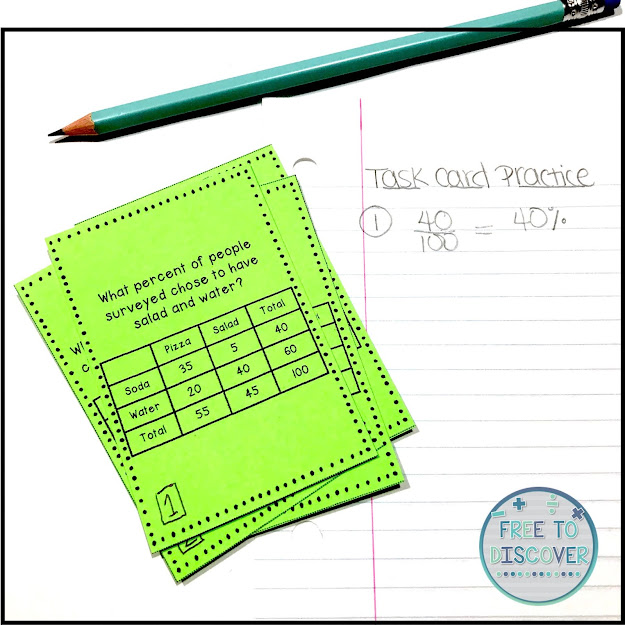

omg cards as task cards


5) Self-Checking Worksheet

Print out the pages to use as worksheets.  Fold the worksheets the “hot dog way” with the problems facing out.  Students look at one side and complete those problems.  By unfolding, they can check their own answer.  This can also be used as a study tool.  The example below demonstrates identifying slope from a linear equation.


self-checking slope from equation activity


6) Exit Tickets

Cut up the cards and pass out for students to complete at the end of a class period.  Data, data, data!  By using similar problems for a few days and recording the results, you will identify measurable growth and see which students still require intervention.  To track data, I use an Excel spreadsheet.  All students' names are listed down the first column.  Then each subsequent column tracks daily exit tickets, and indicates whether students were correct or incorrect.


exit tickets and data


7) Cut-and-Paste Activity

This might also require a bit of creativity to make work, but it will pay off!  Print just the top row of problems.  (You can use a blank piece of paper to cover up the bottom row.)  Print the bottom row separately.  Cut out the bottom row cards.  Students will arrange the bottom row to match up pairs.  They can glue down the cards when they are confident in their answers.


cut and paste matching graphs and standard form linear equations


8) At-Home Practice

Send the cards home!  When playing Old Math Guy with a parent or parents, it may be smart to remove some of the pairs and play the game with a smaller deck.  This is great for remote or distance learning!  You can also refer parents to this YouTube video that explains how to play the game.


YouTube video about omg


9) Partner Search

These cards can be used as a fun way to randomly partner up students.  Pass out one card per student.  Then students move around the room to find the student with a “matching” card.


Phew!  So keep playing Old Math Guy with your students, but try some of these activities to switch it up.  Let me know what you try and how it works out!  


You might also enjoy these related posts:


Subscribe today to receive the game "OMG: Fractions and Decimals!"


Read more »
Free to Discover
0 Comments
20+ Ideas for Teaching with Math Task Cards

20+ Ideas for Teaching with Math Task Cards


20+ ideas for teaching with math task cards

Task cards are everywhere you look because teachers are falling in love with this method of practice! Check out this post for information about WHY to use task cards, HOW to use task cards, and RESOURCES for task cards.


WHY
Task cards are less overwhelming than worksheets because students focus on one problem at a time.  This is helpful for all students, but especially those with attention difficulties.  With worksheets, sometimes I find students having a hard time getting started because the task seems so daunting, but with task cards it is much easier to focus on completing ONE problem… then another, then another.


Task cards can allow for movement as students change stations or walk to retrieve another card.  Movement is so important to incorporate into classes whenever possible.  Think about how much time your students spend sitting throughout the day.  They need opportunities to stand up and move to a different spot in order to wake up the brain!

20+ ideas for teaching with math task cards

Task cards can provide a variety of practice on one topic or several review topics.  They are so versatile!  Sometimes I use sets of task cards with a huge variety of topics to review for state or final exams.  Other times I focus on one topic for more repetition as students are learning a new skill.  The possibilities are endless!

Task cards can be reused again and again because students write in workspaces or a separate piece of paper.  Print on cardstock and laminate so they can stand the test of time and be used again.  You can purchase index card organizers to store them if you have the space.  Little to no prep after year one!

Students enjoy using task cards and show greater engagement than when completing a regular worksheet.  Perhaps the best reason of all… kids love them!  It’s literally a worksheet separated out onto small cards, but many students feel like it is a game.  My middle schoolers love task card days.  J


HOW
My favorite way to use task cards is to leave them in a bin at the front of the room.  Each student begins with one.  They complete the problem in their workspace, then return to the bin to compare their answer with the answer key.  If they are correct, they trade for a new card.  If they are incorrect, they return to their seat to determine their mistake.


Set up 5 or 6 stations around the room with a handful of cards at each.  I project a timer on the front whiteboard and have all students move to the next station at the same time.  Here’s my typical station schedule:
2 minutes: Focus silently and get started.
2 minutes: Collaborate with peers in your group.
1 minute: Check answers and wrap up.
I give my students verbal instructions when it’s time to collaborate and check answers.  During this time I walk around, help students get started if needed, answer questions, etc.

Place each card at a different location around the room and have students move around to complete them all.  They could be taped to walls with students using clipboards or set on desks so students can sit.  Switch it up and see what your students respond better to!

20+ ideas for teaching with math task cards

Give each student a different card to complete as a Problem of the Day or Exit Ticket.  Have students trade with others so they complete 3-5 problems.  This version is for quick checks that only need 5 minutes or so.  Students stay in their seats but get some quick practice.

Project some cards on the front board to discuss as a whole class.  This strategy could make a good opener before sending students off to practice on their own.  This method is also great for reteaching a concept or having students record some examples into a notebook.

Print out and use them as worksheets or a packet.  Of course there’s the traditional practice packet that works well, too!  In this case, students could write directly on the pages as there should be plenty of space to write.


EVEN MORE SUCCESSFUL STRATEGIES


Learning Made Radical: Ideas on Using Task Cards


RESOURCES
Looking for some ready-made resources?  I have FREE set of task cards for reviewing functions on my blog.  My full collection of task cards can be found here.


Smith Curriculum and Consulting put a new spin on using task cards in the classroom with her product: Left, Right, Answer!  Learn more here.

Scaffolded Math & Science offers a free set of Domain and Range Intervention Task Cards.  Scoop them up here.


Here are some related posts you might enjoy:


Subscribe today to receive a free resource in your email inbox!


Read more »
Free to Discover
0 Comments
4 Fun and Effective End of Year Math Review Activities for Middle School

4 Fun and Effective End of Year Math Review Activities for Middle School


Whether you are preparing your students for standardized tests, finals, or working to build retention with spiral review, these resources will knock your socks off with their effectiveness and the student engagement they elicit.

BINGO
Collaborative, Hands-On & “Wicked Awesome”
Hands down my favorite way to review, BINGO games encourage collaboration among students.  Students work in groups to answer review questions.  Watching my students teach each other and witnessing light bulb moments all around the room is my favorite part of this super fun activity.  Check out the available games for 7th grade and 8th grade.

Task Cards
Endless Possibilities
Available in 5th grade, 6th grade, 7th grade, and 8th grade, these sets of 60 task cards provide an overall review of the Common Core State Standards for each grade level.  My favorite way to use task cards is to leave them in a bin at the front of the room.  Each student begins with one.  They complete the problem in their workspace, then return to the bin to compare their answer with the answer key.  If they are correct, they trade for a new card.  If they are incorrect, they return to their seat to determine their mistake.  This strategy encourages movement, self-checking, and independence while students review grade level material.

Scavenger Hunts
Incorporating Movement in Your Classroom
Scavenger Hunts are my students’ favorite way to review!  Students move at their own pace to complete practice problems in a specific order.  Their answers lead them to the next problem.  They can work together or independently while they review end of year material.  While students are working, I walk around to target students who may require some reteaching.  Available in 5th grade, 6th grade, 7th grade, 8th grade, and Algebra 1.

Summer-Themed Practice
Engaging and Self-Checking
These stations are so unique and effective.  Students travel in pairs to solve review problems.  Each partner solves a different problem but they should arrive at the same answer.  Then they use the provided key to acquire 8 letters that can be unscrambled to spell the secret code word.  Promotes movement, collaboration, independence, critical thinking, and review.  Available in 7th grade and 8th grade.

Check out all of my end of year resources here!

Subscribe today to receive a free resource in your email inbox!


Here are some related posts you might enjoy.


Read more »
Free to Discover
1 Comments