Showing posts with label Slope. Show all posts
9 Alternative Ways to Use OMG Cards

9 Alternative Ways to Use OMG Cards


9 alternative ways to use omg cards


Old Math Guy is a super fun math card game.  Students love to play this engaging game in small groups.  You can learn more about the original game in this post.  This particular post is all about 9 alternative ways to use your OMG cards. Here are some ideas for switching it up:


1) Memory Game

Students can use these cards to play a memory game in pairs.  Turn all cards over and students can take turns turning two cards over to try and find pairs.  Unlike traditional memory games, the “pairs” are not the SAME, but they do MATCH.  For example, one card could be a graph and another is an equation but they represent the same function.  Or they could be algebraic expressions represented two different ways (factored and unfactored).  In the photo below, students find matching pairs involving square and cube roots.  This game promotes memory skills as well as math skills.  You could even include the two versions of the actual Old Math Guy in the game just for fun!


square and cube roots memory game with omg cards


2) Matching Activity

Give a pair or small group a deck of OMG cards and have them lay out the cards face up.  Then students can work together to find the “matches.”  This activity promotes great math discussions, and may help work through student misconceptions.  You could incorporate requirements such as (1) students must take turns finding a match or (2) once you find a match, you must show your group and say why it is a match.  In the photo below, students find matching pairs of linear graphs and equations in slope intercept form.


matching graphs and equations with omg cards


3) Flash Cards

This activity may require a little creative assembly and prep time.  Attach the pairs front and back so one side will be the “question” and the other side will be the “answer.”  Students can quiz each other or quiz themselves.  This could be a great tool to send home for extra practice.  I create the flashcards shown below by gluing the pairs front to back.


flash cards with omg cards


4) Task Cards

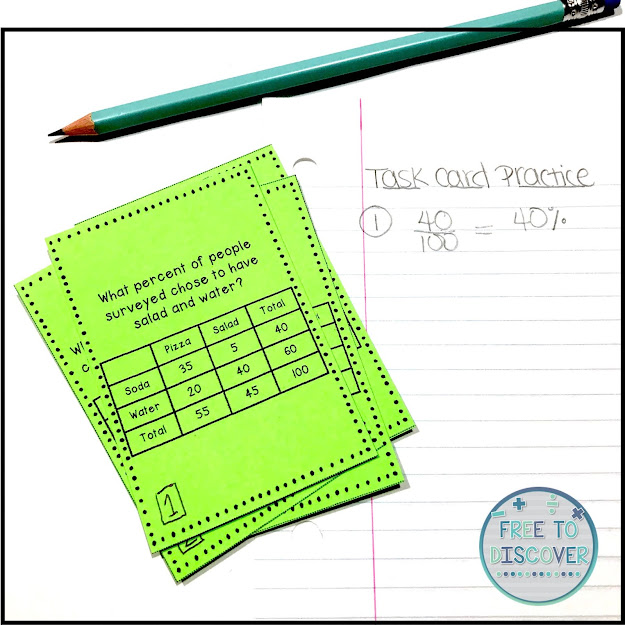
Who doesn’t love a good set of task cards?  Number the two-way tables 1-19.  Once the cards are numbered, cut them up so students can focus on one problem at a time.  This is an effective activity for struggling or anxious learners.  Check out this post for more ideas on how to use task cards in your math classroom.

omg cards as task cards


5) Self-Checking Worksheet

Print out the pages to use as worksheets.  Fold the worksheets the “hot dog way” with the problems facing out.  Students look at one side and complete those problems.  By unfolding, they can check their own answer.  This can also be used as a study tool.  The example below demonstrates identifying slope from a linear equation.


self-checking slope from equation activity


6) Exit Tickets

Cut up the cards and pass out for students to complete at the end of a class period.  Data, data, data!  By using similar problems for a few days and recording the results, you will identify measurable growth and see which students still require intervention.  To track data, I use an Excel spreadsheet.  All students' names are listed down the first column.  Then each subsequent column tracks daily exit tickets, and indicates whether students were correct or incorrect.


exit tickets and data


7) Cut-and-Paste Activity

This might also require a bit of creativity to make work, but it will pay off!  Print just the top row of problems.  (You can use a blank piece of paper to cover up the bottom row.)  Print the bottom row separately.  Cut out the bottom row cards.  Students will arrange the bottom row to match up pairs.  They can glue down the cards when they are confident in their answers.


cut and paste matching graphs and standard form linear equations


8) At-Home Practice

Send the cards home!  When playing Old Math Guy with a parent or parents, it may be smart to remove some of the pairs and play the game with a smaller deck.  This is great for remote or distance learning!  You can also refer parents to this YouTube video that explains how to play the game.


YouTube video about omg


9) Partner Search

These cards can be used as a fun way to randomly partner up students.  Pass out one card per student.  Then students move around the room to find the student with a “matching” card.


Phew!  So keep playing Old Math Guy with your students, but try some of these activities to switch it up.  Let me know what you try and how it works out!  


You might also enjoy these related posts:


Subscribe today to receive the game "OMG: Fractions and Decimals!"


Read more »
Free to Discover
0 Comments
Teaching Writing Linear Equations

Teaching Writing Linear Equations


Teaching students how to write linear equations is my favorite unit.  There’s ample opportunity for exploration and discovery, applications, and extensions!

My students would tell you that I say this about every lesson, but I really think that teaching students how to write linear equations is my favorite unit.  There’s ample opportunity for exploration and discovery, applications, and extensions!

Explore the Ideas
The unit that precedes writing equations is typically centered on slope and rate of change.  I get so excited when we start looking at equations and graphs in terms of slope that I usually start pointing out patterns or leading students to make connections and draw inferences about the y-intercept themselves.  At this point, we typically spend a little time looking at arithmetic sequences.  We use the arithmetic sequence formula, and then discover patterns to formulate our own formula (which – ahem – is basically slope-intercept form).
Teaching students how to write linear equations is my favorite unit.  There’s ample opportunity for exploration and discovery, applications, and extensions!


CCSS 8.EE.B.6 mandates that we “use similar triangles to explain why the slope m is the same between any two distinct points… [and] derive the equation y=mx for a line through the origin and the equation y=mx+b for a line intercepting the vertical axis at b.”  I’ve created a discovery worksheet that facilitates the exploration of these big ideas.  You can scoop it up here.
Teaching students how to write linear equations is my favorite unit.  There’s ample opportunity for exploration and discovery, applications, and extensions!


Get the Basics
Organized notes and repetitive reminders of the steps are super important here.  I will typically create an anchor chart that outlines the steps given each potential set of information.  Notice all of the exact language that I use (also great for your ELLs).
Teaching students how to write linear equations is my favorite unit.  There’s ample opportunity for exploration and discovery, applications, and extensions!


Demonstrate a variety of examples and allow students ample time to practice their new skills.  I teach in a 55-60 minute class period, and I spend two days on each topic: writing equations given a graph (or slope and y-intercept), writing equations given the slope and a point, writing equations given two points.  The first day we take notes and begin to practice the new skill.  Then we continue hands-on practice on the second day.  Check out my differentiated notes and practice here.  Opportunities for differentiation here!
Teaching students how to write linear equations is my favorite unit.  There’s ample opportunity for exploration and discovery, applications, and extensions!


Make it Real
I’m not talking about textbook word problems here… snore.  Cow population, birth defects, what??  There are so many examples of linear relationships in our students’ lives.  Use examples about social media, sports, music, etc.  I have a set of rate of change and initial value task cards that uses real examples. 
Teaching students how to write linear equations is my favorite unit.  There’s ample opportunity for exploration and discovery, applications, and extensions!


Students also love the analysis and discussion required for this discovery worksheet about planning a road trip.  Ask students to draw inferences, make predictions using their equation, discuss limitations, and – most importantly – allow time for debate.  You will turn those adolescent brains right on when they get to argue, and your colleagues in the humanities will thank you for practicing supporting arguments with evidence.
Teaching students how to write linear equations is my favorite unit.  There’s ample opportunity for exploration and discovery, applications, and extensions!


Practice Makes Permanent
Here’s a fun way to practice a new skill or review at the end of the unit:
~ NOTE ~ Depending on your comfort level with thinking on the fly this lesson could potentially have ZERO prep.
1)   Everyone sits at their desk with a piece of notebook paper and a pencil.
2)   4-5 students at a time go to your front whiteboard.  (I rotate through the class to make sure everyone gets up once before repeating volunteers.  This means I often end up with a few “non-volunteers” at the end.  I typically motivate students to volunteer early because they know the rule is that the practice problems generally get harder as we go.)
3)   Announce a slope and a point (for example).  Everyone at their desk writes down the information on their paper at the same time that the volunteers on the front board use the whiteboard markers.  Everyone in the class writes the equation given that information.  I focus on the students at the front and provide subtle redirection as needed, scan the class to make sure everyone is working, and provide assistance to a student or two at their seats if needed.
4)   We discuss things that are great or potential pitfalls to watch for then repeat with a new group at the front board.
5)   Everyone loves it!  And seriously… I very rarely prep for this lesson.

And of course I’d be remiss if I didn’t mention that I have a super popular OMG game for this topic.  Haven’t played yet? 
O. M. G… you don’t know what you’re missing!  ;)
Teaching students how to write linear equations is my favorite unit.  There’s ample opportunity for exploration and discovery, applications, and extensions!


Extend the Unit
So many opportunities for extension here!  You could introduce relationships with parallel or perpendicular lines, scatter plots (and really collect data), standard form of linear equations, graphing calculator extensions and more!

Here’s a fun one for your high flyers:
Write the equation of the line perpendicular to 2x-y=8 that shares the same x-intercept as the given line.
(Answer: y=-0.5x+2)

Join in the conversation!  What are your favorite ways to teach students how to write linear equations?

Subscribe today to receive a free middle school math resource!


Check out these similar posts:


Read more »
Free to Discover
0 Comments
Strategies and activities for teaching slope and rate of change

Strategies and activities for teaching slope and rate of change


4 strategies and resources for teaching rate of change and slope

I am very excited to participate in Education with DocRunning’s Teacher Treats Blog Hop.  I am currently teaching slope and rate of change to my eighth grade students, so I’d love to share some strategies and activities that my students and I love.


1 – Undeniably Terrifying!
It’s true.  I have lived in New Hampshire all my life and I can’t ski.  I went on one ski trip as an eighth grader and all was going well until my friend convinced me to take on a very, very difficult trail.  Let’s just say I knew that as the ski lift climbed higher and higher up the mountain that I would not be skiing down.  Long story short, I held down the bar when we got to the top and convinced the employees to let us ride back down on the lift.  I love sharing this story with my eighth graders and I spare no detail.  Every year I have all eyes locked on me, total engagement, as I tell them about my personal experience.  The UNDEniably terrifying mountain that appeared to have UNDEfined slope.  When possible, I love to use personal anecdotes with my students.  I think it’s a great way to build relationships with students, and, in the very least, it wakes them right up!

2 – Soccer in Math?
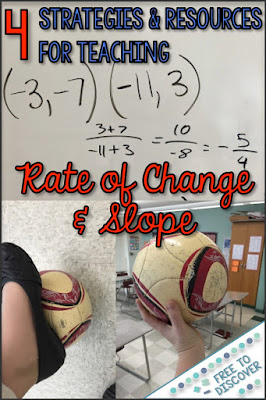
My students in standard level eighth grade math struggle to understand the difference between zero and undefined slope.  I couple of years ago I drew some symbols on the front whiteboard and said aloud, “Imagine the 0 is a ball that someone is standing on.”  Somehow that simple statement has evolved into a demonstration of me standing on a soccer ball in front of my students.  (You might even find a vine somewhere floating around if you search crazy math teacher on soccer ball.)  The connection is that if I hold the ball over my head there is ZERO excitement.  If I stand on top of the ball I will UNDoubtably fall over (hopefully without injury).  As silly as this demonstration is, I believe it gives them a visual to associate with an otherwise abstract concept.

Another strategy that helps reinforce this topic is using the multiplication check.  I start by reminding students that we know 12/3=4 and 4*3=12.  So 0/3=0 because 0*3=0 (check in reverse).  However, 3/0 cannot equal 0 because 0*0 does not equal 3.  The answer must be undefined.

3 – Whiteboard Volunteers and Non-volunteers
My eighth graders love to write on my whiteboard.  Consider ditching the worksheet and inviting students to write on the front board.  I use this practice method for many different skills.  I invite 5 volunteers to front board.  Students at their desk each have a piece of paper that they are writing on.  For slope, I would read aloud two points and ask everyone to find the slope of the line that passes through the two points.  Students at their desks try the problem on their paper, while I can monitor the progress of students at the front board.  Everyone tries the same problem at the same time.  After everyone finishes the problem, we discuss anything tricky or interesting and then rotate to have five new volunteers come to board.  Some classes are more willing and eager to come to the board than others.  I refer to students who need some coaxing as “non-volunteers,” and require that all students come up to board at least once.  I try to be strategic when selecting groups of students so that I can differentiate based on readiness and help all students build confidence.


4 – Differentiating Instruction
I try to differentiate based on readiness and interest where possible.  One idea that I picked up at a conference years ago is the idea of differentiating by designing a “menu.”  I designed a slope menu that is sorted by appetizers, entrees, and desserts.  The appetizers have skill-based questions, entrees consist of higher order thinking conceptual tasks, and desserts are fun, hands-on applications.  Students are instructed to select at least one task from each part of the menu.  Each question is assigned a point value, and students are assigned a required total value they must complete.  They can choose any combination of problems they want as long as they reach the required minimum points value.  This is a fun twist on worksheet practice and it allows students to have choice regarding the type of practice they complete.  I further differentiate by encouraging my high flyers to focus on the higher order thinking questions and check in to make sure my struggling learners understand how to complete all of the skills-based problems.  Here are some sample problems:


Slope has great connections to the world around us, and it tends to bring out my creative side.  I would love for you to comment below with activities and strategies that you love to use when teaching slope and rate of change in your classroom.  Thanks for stopping by!

Stop by my TpT store for tons of awesome resources related to slope and rate of change!  This truly is one of my favorite topics.  :)


And if you'd love a free resource and tons of additional creative ideas, subscribe to the Free to Discover blog:


Read more »
Unknown
0 Comments