Showing posts with label Games. Show all posts
9 Alternative Ways to Use OMG Cards

9 Alternative Ways to Use OMG Cards


9 alternative ways to use omg cards


Old Math Guy is a super fun math card game.  Students love to play this engaging game in small groups.  You can learn more about the original game in this post.  This particular post is all about 9 alternative ways to use your OMG cards. Here are some ideas for switching it up:


1) Memory Game

Students can use these cards to play a memory game in pairs.  Turn all cards over and students can take turns turning two cards over to try and find pairs.  Unlike traditional memory games, the “pairs” are not the SAME, but they do MATCH.  For example, one card could be a graph and another is an equation but they represent the same function.  Or they could be algebraic expressions represented two different ways (factored and unfactored).  In the photo below, students find matching pairs involving square and cube roots.  This game promotes memory skills as well as math skills.  You could even include the two versions of the actual Old Math Guy in the game just for fun!


square and cube roots memory game with omg cards


2) Matching Activity

Give a pair or small group a deck of OMG cards and have them lay out the cards face up.  Then students can work together to find the “matches.”  This activity promotes great math discussions, and may help work through student misconceptions.  You could incorporate requirements such as (1) students must take turns finding a match or (2) once you find a match, you must show your group and say why it is a match.  In the photo below, students find matching pairs of linear graphs and equations in slope intercept form.


matching graphs and equations with omg cards


3) Flash Cards

This activity may require a little creative assembly and prep time.  Attach the pairs front and back so one side will be the “question” and the other side will be the “answer.”  Students can quiz each other or quiz themselves.  This could be a great tool to send home for extra practice.  I create the flashcards shown below by gluing the pairs front to back.


flash cards with omg cards


4) Task Cards

Who doesn’t love a good set of task cards?  Number the two-way tables 1-19.  Once the cards are numbered, cut them up so students can focus on one problem at a time.  This is an effective activity for struggling or anxious learners.  Check out this post for more ideas on how to use task cards in your math classroom.
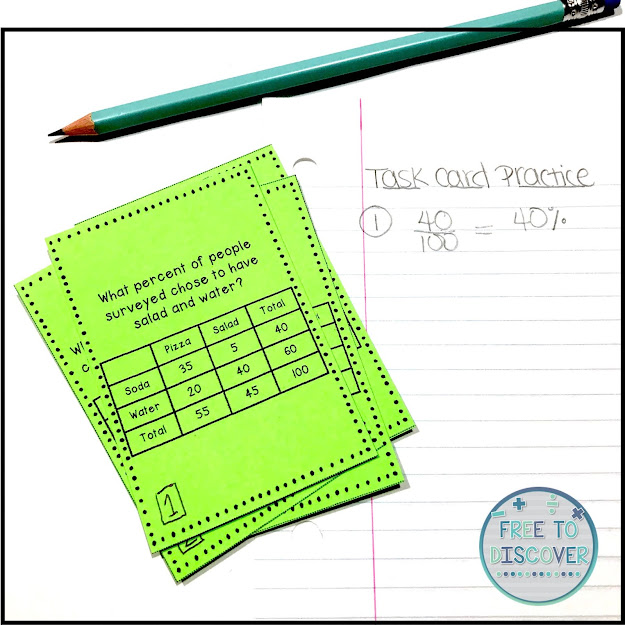

omg cards as task cards


5) Self-Checking Worksheet

Print out the pages to use as worksheets.  Fold the worksheets the “hot dog way” with the problems facing out.  Students look at one side and complete those problems.  By unfolding, they can check their own answer.  This can also be used as a study tool.  The example below demonstrates identifying slope from a linear equation.


self-checking slope from equation activity


6) Exit Tickets

Cut up the cards and pass out for students to complete at the end of a class period.  Data, data, data!  By using similar problems for a few days and recording the results, you will identify measurable growth and see which students still require intervention.  To track data, I use an Excel spreadsheet.  All students' names are listed down the first column.  Then each subsequent column tracks daily exit tickets, and indicates whether students were correct or incorrect.


exit tickets and data


7) Cut-and-Paste Activity

This might also require a bit of creativity to make work, but it will pay off!  Print just the top row of problems.  (You can use a blank piece of paper to cover up the bottom row.)  Print the bottom row separately.  Cut out the bottom row cards.  Students will arrange the bottom row to match up pairs.  They can glue down the cards when they are confident in their answers.


cut and paste matching graphs and standard form linear equations


8) At-Home Practice

Send the cards home!  When playing Old Math Guy with a parent or parents, it may be smart to remove some of the pairs and play the game with a smaller deck.  This is great for remote or distance learning!  You can also refer parents to this YouTube video that explains how to play the game.


YouTube video about omg


9) Partner Search

These cards can be used as a fun way to randomly partner up students.  Pass out one card per student.  Then students move around the room to find the student with a “matching” card.


Phew!  So keep playing Old Math Guy with your students, but try some of these activities to switch it up.  Let me know what you try and how it works out!  


You might also enjoy these related posts:


Subscribe today to receive the game "OMG: Fractions and Decimals!"


Read more »
Free to Discover
0 Comments
4 Fun and Effective End of Year Math Review Activities for Middle School

4 Fun and Effective End of Year Math Review Activities for Middle School


Whether you are preparing your students for standardized tests, finals, or working to build retention with spiral review, these resources will knock your socks off with their effectiveness and the student engagement they elicit.

BINGO
Collaborative, Hands-On & “Wicked Awesome”
Hands down my favorite way to review, BINGO games encourage collaboration among students.  Students work in groups to answer review questions.  Watching my students teach each other and witnessing light bulb moments all around the room is my favorite part of this super fun activity.  Check out the available games for 7th grade and 8th grade.

Task Cards
Endless Possibilities
Available in 5th grade, 6th grade, 7th grade, and 8th grade, these sets of 60 task cards provide an overall review of the Common Core State Standards for each grade level.  My favorite way to use task cards is to leave them in a bin at the front of the room.  Each student begins with one.  They complete the problem in their workspace, then return to the bin to compare their answer with the answer key.  If they are correct, they trade for a new card.  If they are incorrect, they return to their seat to determine their mistake.  This strategy encourages movement, self-checking, and independence while students review grade level material.

Scavenger Hunts
Incorporating Movement in Your Classroom
Scavenger Hunts are my students’ favorite way to review!  Students move at their own pace to complete practice problems in a specific order.  Their answers lead them to the next problem.  They can work together or independently while they review end of year material.  While students are working, I walk around to target students who may require some reteaching.  Available in 5th grade, 6th grade, 7th grade, 8th grade, and Algebra 1.

Summer-Themed Practice
Engaging and Self-Checking
These stations are so unique and effective.  Students travel in pairs to solve review problems.  Each partner solves a different problem but they should arrive at the same answer.  Then they use the provided key to acquire 8 letters that can be unscrambled to spell the secret code word.  Promotes movement, collaboration, independence, critical thinking, and review.  Available in 7th grade and 8th grade.

Check out all of my end of year resources here!

Subscribe today to receive a free resource in your email inbox!


Here are some related posts you might enjoy.


Read more »
Free to Discover
1 Comments
Testing is Over: Now What?!

Testing is Over: Now What?!


Testing is over… now what?  Get inspired with these 14 end of year ideas for your classroom!  Student and teacher tested and approved!

Testing is over… now what?  Get inspired with these 14 end of year ideas for your classroom!  Student and teacher tested and approved!  J

Review Project
Put your students in the driver’s seat for their learning.  Before final exams assign students to groups to review topics from throughout the year.  Presentations can include a lecture and an activity to help their classmates practice the skill.  So fun!

Extension Project
For your higher-level classes, give them the opportunity to research a topic you did not discuss in class.  Allow students to set up projects around the room so their peers can review the research and make notes of interesting facts or connections.

Preview Topics for Next Year
I think I enjoy this more than my students but it’s a goodie!  There are definitely times when structure is better at the end of the year.  Have students take notes on a topic related to what you’ve been learning but didn’t have time to completely cover or will be covered in the following year.  As an Algebra I teacher, I love previewing connections to Geometry or Algebra II.

Testing is over… now what?  Get inspired with these 14 end of year ideas for your classroom!  Student and teacher tested and approved!Chalk Practice
Do you catch your students staring out the window when it’s 80 degrees and sunny?  In New England we only get a few of these days before school gets out so I love to bring the practice outside!  Give students a list of problems to complete on the pavement with chalk.  So much more fun and much less complaining!

Outdoor Class
Or hold the entire class outside!  Give students a packet or activity and a clipboard, and let them work independently or in pairs outside in the grass.  This is my favorite thing to do after state testing because it gets students fresh air and allows them to work at a casual pace after they’ve already worked hard all day.

Charades
Played just like the regular version, allow students to group up.  Have a list of academic topics and/or funny memories from class prepared.  Students then select a paper and act it out!

Surveys
Surveys are great way to gather student feedback, especially if you tried something new.  One of my favorite things to ask is the rank of their favorite projects.  I don’t always realize along the way which projects students loved and which were more of a pain.

Organize Classroom
One of the last few days I put my students to work!  They love to help clean and organize shelves and closets.  Best of all, it saves me from having to stay late on the last days of school!

Testing is over… now what?  Get inspired with these 14 end of year ideas for your classroom!  Student and teacher tested and approved!
Clip Art by Sarah Pecorino Illustration
Test Markers and Other Supplies
Students will enjoy doing other monotonous jobs as well!  Have students check markers and pens to see if they’re still working.  Throw away or upcycle whatever is dried up.


Watch a Movie
Setting up a content-related movie is a great plan when collecting textbooks or passing back lots of work at the end of year.  For 8th grade math, Donald Duck in Mathmagic Land is always a favorite!

Advice for Next Year’s Students
Have students write down their best advice for incoming students.  What inside knowledge do they wish they had starting the school year?  Shana of Scaffolded Math and Science has a great resource for this.  You may even be getting your bulletin board done for the fall!

Game Day
When all the learning is done but you still want a semi-structured activity, host a Game Day.  Students bring in their logic-themed games and sign up to play the games of their choice.  Promotes cooperative learning and critical thinking so you can even write some objectives on the board for your administration.  J

Letters to Teachers
I inherited this activity from a retired teacher and it is awesome!  Give students 20 minutes or so to write a letter of appreciation to an adult in the building who had an impact on them throughout their years at the school.  (I teach 8th grade math so my students have been at the school since 6th grade and are heading off to high school.)  Then sort through the letters by teacher and scan for appropriateness.  Deliver this pleasant surprise to teacher mailboxes.

Locker Clean-Out Trick
Have you seen how much stuff gets thrown out on locker clean-out day?  I leave out two boxes and stand near the trash.  Any pencils or other writing utensils being thrown out go in one and any binders, paper, notebooks, supplies go in the other.  Awesome way to start a collection of extra supplies for next year!

Subscribe to receive a free middle school math resource!  Then stop by the links below for more great ideas and resources!


Subscribe to the Free to Discover blog here:


Read more »
Free to Discover
0 Comments
Teaching Transformations

Teaching Transformations


Transformations can be so difficult for students to visualize.  It’s really important for middle and high school students to engage in hands-on activities that facilitate a concrete understanding of the topics, without simply memorizing some rules.  Here are four strategies to consider when planning your transformations unit.

Transformations can be so difficult for students to visualize.  It’s really important for middle and high school students to engage in hands-on activities that facilitate a concrete understanding of the topics, without simply memorizing some rules.  Here are four strategies to consider when planning your transformations unit.

Consider introducing the topic using manipulatives.  To be able to hold a polygon and then move it, flip it, or rotate it can make a big difference for students.  They don’t have to “envision” something happening to the polygon, they get a concrete answer to their “what happens if” questions.  Try this free lesson in your class:
Transformations can be so difficult for students to visualize.  It’s really important for middle and high school students to engage in hands-on activities that facilitate a concrete understanding of the topics, without simply memorizing some rules.  Here are four strategies to consider when planning your transformations unit.Transformations can be so difficult for students to visualize.  It’s really important for middle and high school students to engage in hands-on activities that facilitate a concrete understanding of the topics, without simply memorizing some rules.  Here are four strategies to consider when planning your transformations unit.


Allow students to discover the big ideas.  A few months ago I was working as a math interventionist with a small group of eighth graders who were learning transformations.  I asked a few questions at the start of the lesson to gauge what they already knew.  They could recall some of the “rules” and “formulas” for what happens to coordinates given different transformations, but they didn’t really remember which rules pair with which transformations.  The discovery lesson that I brought was a perfect match for their needs.  We practiced rotating polygons around the origin 90, 180, and 270 degrees.  However, we accomplished this not by stating some rules and trying to follow, but instead by turning our paper, visualizing, and using logic to work our way through the problems.  The goal of this lesson was to make meaning out of the rules that we summarized at the end.  My discovery lessons for Rotations, Reflections, Translations, and Dilations can be found in my store.

Transformations can be so difficult for students to visualize.  It’s really important for middle and high school students to engage in hands-on activities that facilitate a concrete understanding of the topics, without simply memorizing some rules.  Here are four strategies to consider when planning your transformations unit.


Engage students in hands-on learning.  Once students have played with the ideas and taken notes on the concepts, allow plenty of time to practice using different activities and strategies.  Task cards are great because they allow students to focus on one transformation at a time.  Card sorts allow students to work collaboratively to divide transformations into categories.  Cut and paste activities are also really engaging for students!  Also, click here to read about how Brigid from Math Giraffe uses plastic plates to engage her students in hands-on learning… such a neat idea!
Transformations can be so difficult for students to visualize.  It’s really important for middle and high school students to engage in hands-on activities that facilitate a concrete understanding of the topics, without simply memorizing some rules.  Here are four strategies to consider when planning your transformations unit.

And, of course, my favorite… play a game!  My students and I love to play Old Math Guy to practice matching graphs with the type of transformation shown.  Visit this post to learn more about how to play Old Math Guy in your classroom. 
Transformations can be so difficult for students to visualize.  It’s really important for middle and high school students to engage in hands-on activities that facilitate a concrete understanding of the topics, without simply memorizing some rules.  Here are four strategies to consider when planning your transformations unit.

Thanks for reading!  You can also scoop up a discounted bundle of all of the resources mentioned in this post here.  Now it’s your turn to join the conversation!  What are your favorite activities when teaching transformations?  Any tips or tricks to share?


For more ideas and resources, subscribe to the Free to Discover blog!  You’ll receive a free resource via email just for signing up!

Read more »
Free to Discover
0 Comments